
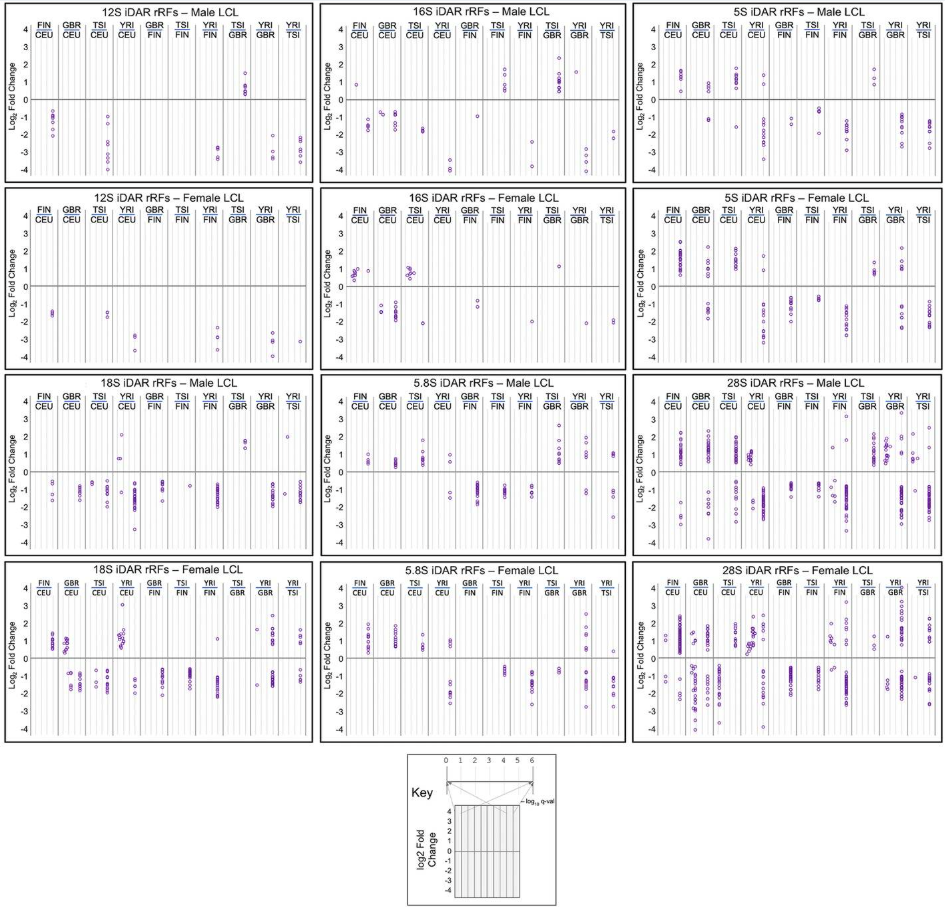
 log2 fold change of iDARs (intersection of differentially abundant rRFs) plotted as a function of significance
Ribosomal RNAs (rRNAs) are core components of the ribosome. Recent sequencing studies revealed the presence of small non-coding RNAs (sncRNAs) whose sequences can only arise from rRNAs. These sncRNAs are known as ribosomal RNA-derived fragments (rRFs) and were originally thought to be random degradation products. In this article, we present evidence that rRFs are produced by cells in a regimented manner and, thus, are not random.
We analyzed
- 434 short RNA-sequencing datasets from lymphoblastoid cell lines (LCLs) from the GEUVADIS repository, which contains samples from participants of the 1000 Genomes Project. The GEUVADIS datasets represented evenly five human populations and both sexes. The populations included Utah Residents with Northern and Western European Ancestry (CEU), Finnish in Finland (FIN), British in England and Scotland (GBR), Toscani in Italia (TSI), and Yoruba from the city of Ibadan, Nigeria (YRI).
- 80 RNA-seq datasets from primary uveal melanoma (UVM) samples from The Cancer Genome Atlas (TCGA).
- Publicly available RNA-seq datasets from 293T cells and extracellular vesicles.
In all cases, the examined rRFs from the four nuclear (5S, 5.8S, 18S, 28S) and two mitochondrial (12S, 16S) rRNAs. In all cases, we found that all six rRNAs produce numerous and abundant rRFs. The rRFs arise from specific regions of the parental rRNAs; exhibit characteristic lengths, endpoints, and abundance profiles; and their abundance levels are comparable to those of established sncRNA classes such as the microRNAs (miRNAs), the miRNA isoforms (isomiRs), and the tRNA-derived fragments (tRFs).
We found that the production of rRFs is highly regulated, with the same rRFs arising from the same “hotspots” and recurring across samples with similar properties. The key findings of this study are that the expression of the rRFs depends on:
- the actual rRF sequence, with rRFs differing by as little as one nucleotide having markedly different abundances;
- personal attributes, namely the sex of the donor and the population to which the donor belongs;
- cellular context, namely, tissue, cell type, and disease.
Indeed, specific rRFs can distinguish between populations, whereas others can distinguish between males and females. Yet other rRFs are preferentially shuttled into exosomes.
To the best of our knowledge, this is the first study that establishes the non-random nature of rRFs and shows that their production depends on sex, population origin, tissue type, and disease. These properties suggest that rRFs play important roles in cellular regulation, warranting further investigation of their function and exploration of their potential as diagnostic and prognostic biomarkers.
References
- Cherlin, T, Magee, R, Jing, Y, Pliatsika, V, Loher, P, Rigoutsos, I. Ribosomal RNA fragmentation into short RNAs (rRFs) is modulated in a sex- and population of origin-specific manner. BMC Biol. 2020;18 (1):38. doi: 10.1186/s12915-020-0763-0. PubMed PMID:32279660 PubMed Central PMC7153239.