
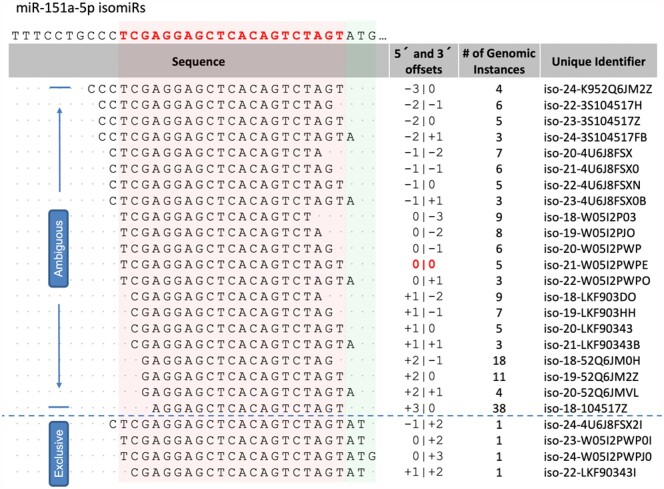
 All possible isomiRs of miR-151a-5p within 3 nts of the endpoints of the miRBase reference miRNA
Motivation: MicroRNA (miRNA) precursor arms generate multiple coexisting isoforms, known as isomiRs, that frequently differ by a few nucleotides at their 5′ and/or 3′ termini. Accumulating evidence shows that isomiR identities and abundances are not fixed, but vary according to tissue type, tissue state, disease subtype, sex, and genetic ancestry. In many contexts, including cancer, the most abundant isomiR differs from the reference miRNA sequence reported in public databases, making accurate and comprehensive isomiR profiling essential for biological interpretation and biomarker discovery. Previous studies have further demonstrated that isomiR expression patterns can discriminate among tissues and cancer subtypes, highlighting their relevance to precision medicine.
Results: We developed isoMiRmap, a fast, standalone, user-friendly tool that identifies and quantifies all isomiRs directly from short RNA-seq datasets. IsoMiRmap is a portable plug-and-play application with modest computational requirements and can process datasets containing tens of millions of reads within minutes on a standard laptop. The tool provides deterministic and exhaustive identification and quantification of isomiRs while avoiding double counting. IsoMiRmap reports all possible parental miRNA precursors, alternative isomiR labels, and genomic coordinates associated with each detected precursor. In addition, it automatically distinguishes isomiRs that are exclusive to miRNA space from those with ambiguous genomic origins, reports overlaps with repeat elements, identifies isomiRs derived from previously unannotated miRNA arms, and detects molecules carrying 3′ non-templated additions. The framework also supports reporting of isomiRs containing documented polymorphisms and somatic mutations from dbSNP, gnomAD, and COSMIC databases. Comparative analyses using real and synthetic datasets show that isoMiRmap identifies more bona fide isomiRs than competing approaches while providing richer annotation and substantially faster execution. By enabling comprehensive characterization of context-dependent isomiR expression, isoMiRmap facilitates studies of tissue specificity, disease heterogeneity, and subtype-associated regulatory variation.
References
- Loher, P, Karathanasis, N, Londin, E, F Bray, P, Pliatsika, V, Telonis, AG, Rigoutsos, I. IsoMiRmap: fast, deterministic and exhaustive mining of isomiRs from short RNA-seq datasets. Bioinformatics. 2021;37 (13):1828-1838. doi: 10.1093/bioinformatics/btab016. PubMed PMID:33471076 PubMed Central PMC8317110.